MASTERING STAINLESS STEEL
A Comprehensive Training Course for Indian Professionals
Discover the power and potential of stainless steel in Indian industries through this interactive and engaging course
Your Course Progress
0%Module 1: Introduction to Stainless Steel
What is Stainless Steel?
Imagine a metal so versatile that it's found in everything from your kitchen sink to surgical implants, from the architectural marvels of modern buildings to the humble pressure cooker in your kitchen! That's stainless steel for you – a remarkable alloy that has transformed our world.
Stainless steel is not just any metal; it's a special iron-based alloy containing a minimum of 10.5% chromium. This chromium is the magic ingredient that creates an invisible protective layer (chromium oxide) on the steel's surface, making it resistant to corrosion and staining – hence the name "stainless"!
Did You Know?
India is the second-largest producer of stainless steel in the world, just behind China! The per capita consumption was 3.1 kg in the fiscal year 2024, and it is expected to rise to 4.5-5.5 kg by 2030.
Key Properties
- Corrosion Resistance: Resists rust and staining
- High Tensile Strength: Durable under stress
- Temperature Resistance: Performs at extreme temperatures
- Hygienic Surface: Ideal for food and medical use
- Recyclability: 100% recyclable material
- Low Maintenance: Easy to clean and care for
- Aesthetic Appeal: Modern, sleek appearance
- Formability: Can be molded into various shapes
The Stainless Steel Journey in India
The Indian Stainless Story
When Rajesh Kumar joined his family's small metalware business in Moradabad in the 1980s, stainless steel was just beginning to replace traditional brass utensils in Indian homes. "My father was skeptical," Rajesh recalls. "He believed brass had cultural significance that stainless steel could never replace."
But Rajesh saw the potential. He invested in stainless steel manufacturing equipment, focusing on traditional Indian cookware designs but made with this modern material. Today, his company exports stainless steel kitchenware to over 20 countries, while maintaining their cultural authenticity.
"Stainless steel revolutionized Indian kitchens," Rajesh explains. "It combined our traditional cooking methods with modern convenience, hygiene, and durability."
In India, stainless steel has a special place in our daily lives. From the iconic stainless steel tiffin boxes that carry millions of lunches every day through Mumbai's dabbawalas, to the gleaming surfaces of our modern infrastructure projects, stainless steel has become deeply integrated into Indian life and industry.
Quick Knowledge Check
1. What minimum percentage of chromium must be present for steel to be considered "stainless"?
2. What is India's position in global stainless steel production?
Module 2: Stainless Steel Classification
AISI Classification System
The American Iron and Steel Institute (AISI) has developed a numbering system that classifies stainless steels into distinct series based on their chemical composition and microstructure. Understanding this classification is crucial for selecting the right material for specific applications.
| Series | Structure | Nickel Content | Key Elements | Main Uses |
|---|---|---|---|---|
| 200 | Austenitic | Low | Mn, N (less Ni) | Cost-effective utensils, decorative items |
| 300 | Austenitic | High | Ni, Cr | Kitchenware, medical, food processing |
| 400 | Ferritic/Martensitic | None or low | Cr | Blades, automotive, cutlery |
Pro Tip
When you see an item labeled as "304 stainless steel," the first digit "3" tells you it belongs to the 300 series, which means it's austenitic with high nickel content – perfect for food-grade applications!
Market Share of Stainless Steel in India
In the Indian market, the 300 series dominates with a 60% share, primarily due to its versatility and superior corrosion resistance. The 200 and 400 series each hold about 20% of the market.
This distribution reflects India's unique industrial and consumer needs. The prevalence of the 300 series is driven by:
- Growing food processing industry requiring hygienic materials
- Expanding healthcare sector demanding high-quality medical equipment
- Increasing infrastructure projects utilizing corrosion-resistant materials
- Traditional preference for durable kitchenware in Indian households
Key Differences Between Series
200 Series
- Austenitic StructureNon-magnetic crystalline structure with excellent ductility
- Low Nickel Content
- High Manganese Content
- Moderate Corrosion Resistance
- High Strength
- Mostly Non-magnetic
- Good Weldability
- Lower Cost
300 Series
- Austenitic StructureNon-magnetic crystalline structure with excellent ductility
- High Nickel Content
- Low Manganese Content
- Excellent Corrosion Resistance
- Moderate Strength
- Mostly Non-magnetic
- Excellent Weldability
- Higher Cost
400 Series
- Ferritic/MartensiticMagnetic crystalline structures with different properties
- None or Low Nickel
- Low Manganese Content
- Low to Moderate Corrosion Resistance
- Moderate Strength
- Magnetic
- Fair Weldability
- Lower Cost
Corporate Example
Tata Steel's stainless division faced a challenge when manufacturing components for a leading automotive client. The components needed to be magnetic for sensor compatibility but also corrosion-resistant for external use. Their materials engineer recommended 430 grade from the 400 series, which provided the perfect balance of magnetic properties and adequate corrosion resistance at a lower cost than 300 series alternatives. This strategic material selection helped secure a 5-year supply contract worth over ₹200 crores.
Quick Knowledge Check
1. Which series has the largest market share in India?
2. Which of the following is true about the 400 Series?
Module 3: Types of Stainless Steel
The Five Families of Stainless Steel
Stainless steel is not a single material but a diverse family with five distinct categories, each with unique properties and applications. These categories are defined by their microstructure – the way the atoms are arranged at the microscopic level.
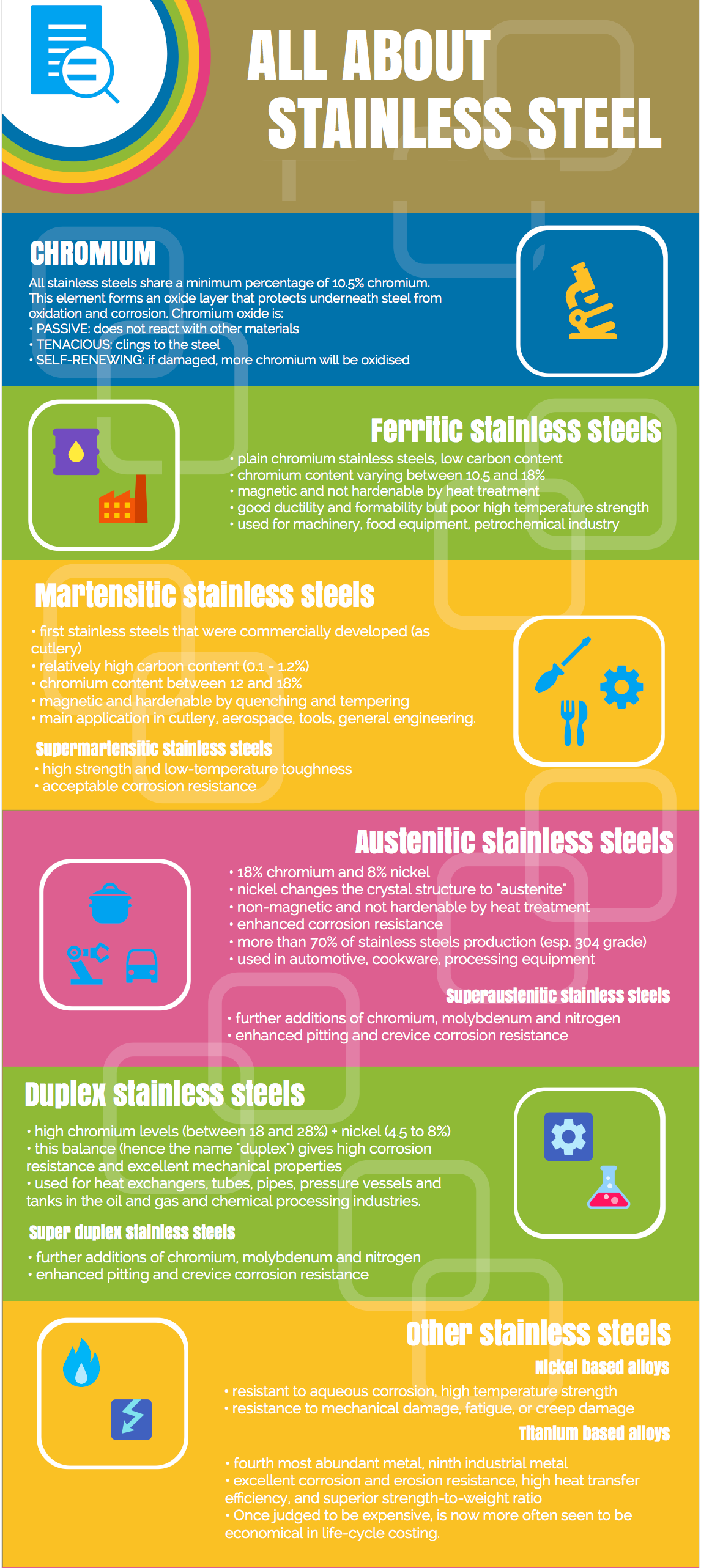
Austenitic
The most common type, non-magnetic and highly resistant to corrosion.
- Structure: Face-centered cubic
- Key Elements: Cr, Ni, Mn
- Properties: Excellent corrosion resistance, good formability, non-magnetic
- Examples: 304, 316, 201
Ferritic
Magnetic stainless steels with moderate corrosion resistance.
- Structure: Body-centered cubic
- Key Elements: Cr (11-27%)
- Properties: Magnetic, good formability, moderate corrosion resistance
- Examples: 430, 409, 434
Martensitic
Hard, strong stainless steels that can be heat-treated.
- Structure: Body-centered tetragonal
- Key Elements: Cr (12-14%), C (0.1-1.2%)
- Properties: High strength, hardness, magnetic, lower corrosion resistance
- Examples: 410, 420, 440C
Duplex
Combines properties of austenitic and ferritic stainless steels.
- Structure: Mixed (50% austenite, 50% ferrite)
- Key Elements: Cr, Ni, Mo, N
- Properties: High strength, good corrosion resistance, improved stress corrosion cracking resistance
- Examples: 2205, 2507, 2304
Precipitation Hardening
High-strength stainless steels developed for specific applications.
- Structure: Varies (austenitic, semi-austenitic, or martensitic)
- Key Elements: Cr, Ni, plus Cu, Al, Ti, Nb
- Properties: Very high strength, good corrosion resistance, specialized applications
- Examples: 17-4PH, 15-5PH, 13-8PH
Applications Across Indian Industries
Austenitic stainless steel is the most widely used type in India, finding applications in:
- Food processing equipment in India's rapidly growing food industry
- Pharmaceutical manufacturing equipment where hygiene is paramount
- Kitchen utensils and cookware in nearly every Indian household
- Architecture and construction, including metro stations and airports
- Chemical processing equipment in industrial applications
Amul's Quality Revolution
When Amul modernized its dairy facilities in Gujarat, they chose grade 316 austenitic stainless steel for all milk processing equipment. This decision not only met international hygiene standards but also extended equipment life by over 15 years due to stainless steel's resistance to cleaning chemicals. The investment initially seemed high compared to alternative materials, but the longevity and reduced maintenance costs resulted in over 30% savings in the long run.
Ferritic stainless steel offers a cost-effective alternative in applications where moderate corrosion resistance is acceptable:
- Automotive exhaust systems for India's booming automobile sector
- Interior architectural panels and trim
- Home appliances including washing machines and refrigerators
- Indoor applications where aesthetics matter but corrosion is less severe
Maruti Suzuki's Material Innovation
Maruti Suzuki India implemented a switch from regular steel to grade 409 ferritic stainless steel for their exhaust systems. This change extended the average lifespan of exhaust components from 3-4 years to over 8 years, significantly reducing warranty claims and enhancing customer satisfaction. The magnetic properties of ferritic stainless also simplified the manufacturing process by allowing magnetic handling equipment to be used during assembly.
Martensitic stainless steel is valued for applications requiring hardness and wear resistance:
- High-quality cutlery manufactured in centers like Moradabad
- Surgical instruments for India's growing medical sector
- Valve components in industrial applications
- Turbine blades in energy generation equipment
Surgical Innovation in Bengaluru
A Bengaluru-based medical device manufacturer developed specialized surgical tools using grade 420 martensitic stainless steel. The tools maintained sharpness even after multiple sterilization cycles, reducing replacement frequency and costs for hospitals. This innovation helped position Indian-made surgical instruments in premium international markets, demonstrating how material selection directly impacts product quality and market positioning.
Duplex stainless steel combines strength and corrosion resistance for demanding applications:
- Chemical processing equipment in harsh environments
- Desalination plants in coastal regions
- Oil and gas equipment for India's energy sector
- Bridge components in corrosive environments
ONGC's Offshore Success
Oil and Natural Gas Corporation (ONGC) faced severe corrosion challenges in their offshore platforms along India's western coast. By replacing conventional materials with duplex stainless steel 2205 for critical seawater-handling components, they reduced maintenance shutdowns by 70% and extended component lifespans by over three times. The initial investment was recovered within just 2.5 years due to reduced downtime and maintenance costs.
Precipitation hardening stainless steel serves specialized needs requiring exceptional strength:
- Aerospace components for India's growing aviation industry
- High-stress fasteners and mechanical components
- Defense equipment requiring both strength and corrosion resistance
- Specialized medical implants and instruments
HAL's Material Evolution
Hindustan Aeronautics Limited (HAL) upgraded critical aircraft components to 17-4PH precipitation hardening stainless steel, achieving a 40% weight reduction while maintaining required strength parameters. This change improved fuel efficiency and reduced maintenance requirements for their aircraft. The specialized nature of this material required developing new manufacturing skills among Indian metallurgists and engineers, demonstrating how advanced materials drive skill development.
Quick Knowledge Check
1. Which type of stainless steel combines properties of austenitic and ferritic structures?
2. Which stainless steel type is most commonly used for surgical instruments?
Module 4: The 200 Series - India's Cost-Effective Champion
Understanding the 200 Series
The 200 series stainless steels were developed as a cost-effective alternative to the more expensive nickel-containing 300 series. This innovation has special relevance for the Indian market, where affordability and value are key purchasing factors.
These steels maintain an austenitic structure but replace some of the nickel with manganese and nitrogen. This substitution provides similar properties to the 300 series at a lower cost, making them particularly important in the Indian market.
Indian Market Insight
The 200 series is especially popular in India for mass-market consumer goods. When global nickel prices surged in the early 2000s, many Indian manufacturers shifted to 200 series stainless steel to maintain affordable price points for consumers while still offering "stainless" products.
Common Grades
-
201Most popular, general purpose
-
202Similar to 201 with slightly higher Cr and Ni
-
204CuHigh formability with added copper
-
205Higher manganese content
Applications of 200 Series in Indian Industry
| Grade | Shape | Industry / End Use | Example Applications |
|---|---|---|---|
| 201 | Flat Coils | Kitchenware, Appliances | Sinks, Pressure cookers, Induction cookware |
| 202 | Flat Coils | Construction, Interior design | Decorative panels, Modular kitchens |
| 204Cu | Flat Coils | Automotive, Deep drawing parts | Car trims, Fuel tank covers |
| 201 | Round Bars | Fasteners & Fittings | Screws, Bolts, Washers |
| 202 | Round Bars | Railings, Architectural | Grills, Handrails |
| 205 | Flat Coils | Consumer Goods, Furniture | Stamped parts, panels, utensils |
Corporate Example: Prestige's Material Strategy
Prestige, a leading kitchen appliance manufacturer in India, faced a challenge when nickel prices surged in 2007, threatening to increase their production costs by over 30%. Their R&D team tested 201 grade stainless steel as an alternative to 304 (from the 300 series) for their budget pressure cooker line.
After extensive testing, they found that 201 provided adequate corrosion resistance for kitchen use while reducing material costs by 22%. They marketed these models as "Stainless Steel Economy" products, creating a new market segment that made pressure cookers affordable for millions more Indian households.
This strategic material decision helped Prestige increase their market share from 37% to 45% in the economy segment within two years, demonstrating how understanding material properties directly impacts business success.
Strengths and Limitations of 200 Series
Advantages
- Cost-effective: Lower nickel content makes it more affordable
- Good strength: Higher than 300 series due to nitrogen addition
- Adequate corrosion resistance: Suitable for indoor applications
- Good formability: Can be easily shaped into complex forms
- Aesthetic appeal: Maintains attractive stainless appearance
- Market familiarity: Well-established in Indian manufacturing
Limitations
- Reduced corrosion resistance: Lower than 300 series in harsh environments
- Potential for magnetic behavior: May show slight magnetic properties after cold working
- Heat resistance: Lower performance at elevated temperatures
- Weldability: More challenging to weld than 300 series
- Not suitable for: Food processing equipment, medical applications
- Perception issues: Sometimes viewed as "inferior" to 300 series
Making the Right Material Choice: A Tale of Two Products
Vijay and Rohit were college friends who started two different stainless steel product companies in Pune.
Vijay launched a line of decorative home items using 201 stainless steel. His products looked great, were affordably priced, and quickly gained popularity. Since these items were primarily decorative and used indoors, the 201 grade performed perfectly. Within three years, his company was supplying to major retailers across western India.
Rohit, however, decided to manufacture outdoor garden tools using the same 201 grade, attracted by its lower cost. Within months of launching, customers began reporting rust spots, especially in coastal regions like Mumbai and Goa. He had to recall products and switch to 304 (300 series) stainless steel, which significantly increased his costs and delayed his market entry by almost a year.
The lesson? The "best" stainless steel isn't about price or prestige – it's about matching the material properties to the application requirements. Vijay's indoor application was perfect for 200 series, while Rohit's outdoor tools needed the superior corrosion resistance of 300 series.
Quick Knowledge Check
1. What element partially replaces nickel in 200 series stainless steel?
2. Which application would be LEAST suitable for 200 series stainless steel?
Module 5: The 300 Series - The Industry Standard
Understanding the 300 Series
The 300 series stainless steels are the most widely used group worldwide and represent 60% of India's stainless steel market. These austenitic stainless steels contain significant amounts of chromium and nickel, giving them excellent corrosion resistance and formability.
Think of 300 series as the "premium segment" of stainless steel – it costs more than other types, but delivers superior performance in challenging environments. This makes it the go-to choice for applications where failure is not an option, such as food processing equipment, medical devices, and chemical industries.
Key Insight
The 300 series dominates India's stainless market because of the country's challenging climate conditions. The combination of high humidity in coastal areas, heavy monsoon seasons, and industrial pollution in urban centers creates corrosive conditions that demand materials with excellent resistance properties.
Common Grades
-
304The most widely used grade ("18-8")
-
316Contains molybdenum for enhanced corrosion resistance
-
321Titanium stabilized for weld applications
-
310High temperature applications
Comparing Key Grades of 300 Series
304 - The Universal Grade
Often called "18-8" (18% chromium, 8% nickel), 304 is the most commonly used stainless steel worldwide and in India. It offers an excellent combination of corrosion resistance, formability, strength, and value.
Key Properties:
- Excellent corrosion resistance
- Good formability
- Easy to clean and sterilize
- Non-magnetic (when annealed)
- Temperature resistance: -196°C to 870°C
Indian Industries Using 304:
- Food and beverage manufacturing
- Kitchen equipment and utensils
- Architectural applications
- Railway coaches (Indian Railways)
- Dairy equipment
Success Story: Indian Railways Transformation
In 2018, Indian Railways began replacing its conventional carbon steel coaches with stainless steel 304 grade coaches. The result? Extended coach life from 25 years to over 35 years, reduced maintenance costs by 35%, improved fuel efficiency due to lighter weight, and enhanced passenger safety in the event of accidents due to superior crash resistance.
This material shift represented one of the largest industrial applications of stainless steel in India, consuming thousands of tons of 304 grade stainless steel and setting new standards for public transportation.
When to Choose 304:
- General purpose applications requiring good corrosion resistance
- Indoor and most outdoor environments (except marine)
- Food processing equipment
- Architectural applications
- When cost is a consideration but performance cannot be compromised
316 - The Marine and Chemical Grade
Grade 316 contains molybdenum, which provides enhanced corrosion resistance, particularly against chlorides (like salt) and industrial chemicals. This makes it the preferred choice for coastal applications, chemical processing, and pharmaceutical equipment.
Key Properties:
- Superior corrosion resistance, especially to chlorides
- Excellent resistance to chemical attack
- Good high-temperature properties
- Non-magnetic (when annealed)
- Higher cost than 304
Indian Industries Using 316:
- Pharmaceutical manufacturing equipment
- Chemical processing plants
- Marine equipment and coastal structures
- Surgical instruments and implants
- High-end kitchen equipment
Success Story: Dr. Reddy's Laboratories
Dr. Reddy's Laboratories, a leading Indian pharmaceutical company, standardized on 316L stainless steel for all their product-contact equipment surfaces. This decision helped them meet international regulatory requirements (FDA and EMA) without additional validation steps, accelerating their global market access.
While the initial investment was 12% higher than using 304 grade, the company calculated that the elimination of compliance risks and potential product recalls resulted in a positive ROI within the first year of implementation.
When to Choose 316:
- Coastal or marine environments
- Chemical processing equipment
- Pharmaceutical manufacturing
- Applications exposed to de-icing salts
- When regulatory compliance is critical
321 - The Welding Specialist
Grade 321 is essentially a modified version of 304 with added titanium. This addition prevents chromium carbide precipitation during welding or high-temperature service, making it ideal for welded components that will be exposed to temperatures between 425-870°C.
Key Properties:
- Excellent resistance to intergranular corrosion after welding
- Good high-temperature strength
- Oxidation resistance up to 870°C
- Better creep resistance than 304
- Good formability and weldability
Indian Industries Using 321:
- Aircraft exhaust systems
- High-temperature chemical processing equipment
- Power generation equipment
- Heat exchangers
- Industrial furnace components
Success Story: BHEL's Power Equipment
Bharat Heavy Electricals Limited (BHEL), India's largest power generation equipment manufacturer, switched to 321 stainless steel for critical components in their high-temperature exhaust systems. This change eliminated weld failures that were occurring with standard 304 grade in service conditions exceeding 500°C.
The improved reliability extended service intervals from 2 years to 5 years, significantly reducing downtime costs for power plants. This material choice became a key selling point for BHEL's export markets, where equipment reliability is paramount.
When to Choose 321:
- Welded components operating at 425-870°C
- Applications where post-weld heat treatment is not possible
- Equipment subjected to thermal cycling
- When intergranular corrosion resistance is critical
- High-temperature exhaust systems
300 Series in Corporate India: Case Studies
Tata Steel's Manufacturing Evolution
When Tata Steel modernized their cold rolling mill in Jamshedpur, they faced a challenge with their acid pickling lines. The carbon steel tanks were corroding rapidly, requiring frequent shutdowns for repairs and creating potential environmental hazards.
After consulting with materials engineers, they replaced the tanks with 316L stainless steel, which offered superior resistance to the acids used in the pickling process. The immediate benefit was a reduction in maintenance shutdowns from 12 times per year to just once annually.
The ROI calculation was compelling: despite a 300% higher initial cost for the stainless steel tanks, the company achieved breakeven in 18 months through reduced maintenance costs, decreased downtime, and longer equipment life. This success led to adopting 316L for all acid-handling equipment throughout their facilities.
Amul's Food Safety Revolution
Amul, India's largest dairy cooperative, standardized on 304 stainless steel for all milk contact surfaces in their processing plants. This decision came after an extensive study of bacterial growth on different materials used in dairy equipment.
The results were significant: bacterial counts dropped by over 90% compared to previously used materials, and product shelf life increased by 30%. The smooth, non-porous surface of 304 stainless proved easier to clean and sanitize, reducing cleaning times and chemical usage.
Most importantly, this material choice became a key part of Amul's food safety story, helping them meet international standards and expand exports to quality-conscious markets. The premium paid for 304 stainless steel was quickly offset by reduced product losses and access to higher-value export markets.
Delhi Metro: A Material Success Story
When Delhi Metro Rail Corporation (DMRC) began planning their massive urban transit system, they made a pioneering decision for Indian infrastructure: using 304 stainless steel for coach bodies instead of conventional carbon steel.
This decision factored in life-cycle costs rather than just initial investment. While the stainless steel coaches cost approximately 15% more upfront, DMRC's analysis showed they would deliver:
- Longer service life (35+ years vs. 25 years for carbon steel)
- Reduced maintenance costs (no painting required, easier cleaning)
- Lower operating costs due to lighter weight (7% less than carbon steel)
- Enhanced passenger safety in collision scenarios
- Better corrosion resistance in Delhi's polluted environment
The success of this material strategy led other Indian metro systems in Mumbai, Bangalore, and Chennai to follow suit. Today, India is one of the world's largest markets for stainless steel metro coaches, demonstrating how material selection at the planning stage can deliver decades of operational benefits.
This case illustrates a key principle: when evaluating stainless steel, organizations should consider total lifecycle cost, not just purchase price. The 300 series often delivers the lowest long-term cost despite higher initial investment.
Quick Knowledge Check
1. Which element is added to 316 stainless steel to improve corrosion resistance?
2. Why is 321 stainless steel preferred for welded components at high temperatures?
Module 6: The 400 Series - Specialized Performers
Understanding the 400 Series
The 400 series stainless steels are fundamentally different from the 200 and 300 series. They contain little or no nickel and have either ferritic or martensitic microstructures, making them magnetic – a key distinguishing feature from austenitic grades.
While holding about 20% of the Indian market, these steels fill specialized niches where their unique properties – including magnetism, hardenability, and wear resistance – make them indispensable for certain applications.
Quick Identification Tip
If a magnet sticks to stainless steel, it's almost certainly from the 400 series. This simple test can help identify the material type in the field when documentation is unavailable.
Two Distinct Types
Ferritic
Contains 11-27% chromium, magnetic, not hardenable, good formability
Martensitic
Contains 11-17% chromium, magnetic, can be hardened, moderate corrosion resistance
Common Grades and Their Applications
Ferritic Grades
The most widely used ferritic grade with 16-18% chromium.
Indian Applications:
- Automotive trim and molding
- Kitchen appliance panels
- Interior architectural components
- Washing machine drums
Lower-cost grade with 11% chromium, often used in automotive exhaust systems.
Indian Applications:
- Automotive exhaust systems
- Mufflers and catalytic converter shells
- Farm equipment
- Heat exchanger tubing
Contains molybdenum for improved corrosion resistance.
Indian Applications:
- Automotive exterior trim
- Decorative building facades
- Indoor architectural components
- Consumer appliance trim
Martensitic Grades
Basic martensitic grade with 11.5-13.5% chromium, heat-treatable.
Indian Applications:
- Valve components in power plants
- Pump shafts
- Fasteners
- Steam turbine blades
Higher carbon content than 410, can be hardened to higher levels.
Indian Applications:
- Surgical instruments
- Kitchen cutlery
- Razor blades
- Plastic molds
High carbon content, can be hardened to very high hardness levels.
Indian Applications:
- High-quality knife blades
- Surgical scalpels
- Ball bearings
- Valve seats in harsh environments
Key Properties and Selection Criteria
Ferritic Stainless Steel
When to Select Ferritic Stainless Steel:
- When magnetic properties are required
- For mild corrosive environments
- When cost is a critical factor
- For applications requiring good formability
- Where heat transfer is important
Martensitic Stainless Steel
When to Select Martensitic Stainless Steel:
- When hardness and wear resistance are primary requirements
- For cutting applications (knives, surgical instruments)
- Where high strength is needed
- Applications requiring magnetic properties
- Where heat treatment can be performed to achieve desired properties
Indian Corporate Success Stories with 400 Series
Tata Motors' Exhaust Innovation
Tata Motors faced a challenge with their commercial vehicle exhaust systems. The conventional carbon steel components were failing prematurely in India's diverse climate conditions, from the coastal humidity of Mumbai to the dusty plains of Rajasthan.
Their engineering team conducted extensive field tests with different materials and settled on 409 ferritic stainless steel for exhaust components. This grade offered the right balance of heat resistance, corrosion protection, and cost-effectiveness for their application.
The results were impressive:
- Exhaust system lifespan increased from 2-3 years to 7+ years
- Warranty claims for exhaust-related issues dropped by 78%
- Customer satisfaction scores improved by 12 percentage points
- The weight reduction of 15% contributed to better fuel efficiency
While the material cost was 45% higher than carbon steel, the extended lifespan and reduced warranty costs delivered a positive ROI within the first year. This success led to the adoption of 409 stainless for all Tata commercial vehicle exhaust systems.
Godrej Appliances' Material Evolution
Godrej Appliances, one of India's leading home appliance manufacturers, sought to differentiate their premium refrigerator line with improved aesthetics and durability. They faced specific challenges with fingerprint marks, cleaning difficulty, and maintaining appearance over the product's lifespan.
After exploring multiple options, they selected 430 ferritic stainless steel with a specialized brush finish for their high-end refrigerator doors. The 430 grade provided:
- Sufficient corrosion resistance for indoor applications
- Excellent formability for the door panels
- Superior appearance retention compared to painted surfaces
- Fingerprint resistance with special finishing techniques
- Magnetic properties that allowed decorative magnets to stick (a consumer preference in Indian households)
This material choice became a key selling point in their marketing, highlighting the "premium stainless finish" that competitors couldn't match at the same price point. Sales of their premium line increased by 34% year-over-year following the introduction of the stainless steel design.
Surgical Innovation: Chennai Surgical Instruments Ltd.
Chennai Surgical Instruments Ltd., a leading manufacturer of medical devices, needed to develop high-precision surgical scalpels for the growing medical tourism industry in India. Their challenge was creating instruments that maintained sharpness through multiple sterilization cycles while meeting international safety standards.
Their metallurgists selected 440C martensitic stainless steel with a specialized heat treatment process. This material provided:
- Exceptional hardness (58-60 HRC) for edge retention
- Sufficient corrosion resistance for medical applications
- Ability to take an extremely fine edge
- Resistance to repeated autoclave sterilization cycles
The resulting scalpels outperformed imported alternatives in clinical testing, retaining sharpness for 35% more procedures. This innovation allowed the company to enter premium export markets in Europe and the Middle East, increasing their profit margins by 28% and establishing India as a source of high-quality surgical instruments.
This example demonstrates how understanding the specialized properties of martensitic stainless steel enabled the development of a high-value product that opened new market opportunities.
Quick Knowledge Check
1. Which key property distinguishes 400 series stainless steels from 300 series?
2. Which 400 series stainless steel grade is commonly used for high-quality knife blades?
Module 7: Special Categories of Stainless Steel
Beyond the Main Series: Specialized Stainless Steels
While the 200, 300, and 400 series form the backbone of the stainless steel industry, two specialized categories deserve attention for their unique properties and growing applications in high-performance sectors.
Duplex Stainless Steel
Duplex stainless steels feature a microstructure that's approximately 50% austenite and 50% ferrite, combining the best properties of both phases.
Key Properties:
- Exceptional strength (about twice that of austenitic grades)
- Excellent resistance to stress corrosion cracking
- Superior corrosion resistance, especially to chlorides
- Good weldability with proper procedures
- Moderate magnetic response
Common Grades:
- 2205 - The most widely used duplex grade
- 2507 - Super duplex for extreme environments
- 2304 - Lean duplex with lower alloy content
Applications in India:
- Desalination plants along coastal regions
- Chemical processing equipment
- Oil and gas infrastructure
- Pulp and paper digesters
- Bridges and structural components in marine environments
Precipitation Hardening Stainless Steel
Precipitation hardening (PH) stainless steels develop extremely high strength through a special heat treatment process while maintaining good corrosion resistance.
Key Properties:
- Very high strength and hardness
- Good corrosion resistance (similar to 304)
- Excellent mechanical properties at high and low temperatures
- Dimensional stability during heat treatment
- Good machinability
Common Grades:
- 17-4PH - Most common PH grade
- 15-5PH - Higher toughness than 17-4PH
- PH 13-8Mo - Exceptional corrosion resistance
Applications in India:
- Aerospace components for ISRO and HAL
- Defense equipment manufacturing
- High-strength fasteners for critical applications
- Valve components in power generation
- Specialized medical implants and instruments
Corporate Success Stories
ISRO's Material Innovation
The Indian Space Research Organisation (ISRO) faced a critical challenge in developing fuel injection components for their cryogenic engines. These components needed to combine exceptional strength with corrosion resistance in the presence of liquid oxygen and hydrogen.
After extensive testing, ISRO's materials scientists selected 17-4PH precipitation hardening stainless steel, heat treated to achieve the H900 condition. This provided the perfect combination of properties:
- Tensile strength exceeding 1380 MPa (200,000 psi)
- Excellent dimensional stability during thermal cycling
- Corrosion resistance to propellants and atmospheric conditions
- The ability to be manufactured with the precision required for rocket engines
This material choice contributed to the success of India's indigenous cryogenic engine program, reducing dependence on imported technology. The precision 17-4PH components performed flawlessly during the GSLV-MkIII launches, validating the material selection strategy and demonstrating Indian expertise in advanced materials.
L&T's Desalination Breakthrough
Larsen & Toubro (L&T) secured a contract to build a major desalination plant in Tamil Nadu, but faced significant materials challenges due to the extremely corrosive seawater environment combined with high operating pressures.
Conventional austenitic stainless steels (304/316) lacked the necessary strength for high-pressure components, while carbon steel couldn't withstand the corrosive environment. L&T's engineering team selected 2205 duplex stainless steel for critical components in the reverse osmosis system.
This material selection delivered multiple benefits:
- The superior strength of duplex allowed for thinner wall sections, reducing weight and cost
- Excellent resistance to chloride pitting corrosion extended component lifespan
- Higher fatigue strength improved performance under cyclic loading conditions
- Lower thermal expansion provided better dimensional stability
While the initial material cost was 15% higher than the original specification, the improved performance and extended maintenance intervals delivered a total cost of ownership that was 23% lower over the 20-year design life. This project established L&T as a leader in desalination technology and created new opportunities in water infrastructure projects across Asia.
Material Selection Decision Matrix
When selecting stainless steel for a specific application, consider these key factors and match them to the appropriate type:
| Application Need | Best Choice | Runner-Up | Avoid |
|---|---|---|---|
| Maximum corrosion resistance | 316 (Austenitic) | Duplex 2205 | 400 Series |
| Coastal/marine environment | Duplex 2205 | 316 (Austenitic) | 200 Series |
| Food contact applications | 304 (Austenitic) | 316 (Austenitic) | Non-stabilized 400 Series |
| Cost-effective indoor use | 200 Series | 430 (Ferritic) | Specialty grades |
| Maximum hardness/edge retention | 440C (Martensitic) | 420 (Martensitic) | Austenitic grades |
| High strength requirements | 17-4PH (Precipitation Hardening) | Duplex 2205 | Ferritic grades |
| Elevated temperatures (>500°C) | 321 (Austenitic) | 309/310 (Austenitic) | Precipitation Hardening |
| Magnetic requirement | 430 (Ferritic) | 410 (Martensitic) | Austenitic grades |
| Decorative applications | 304 (Austenitic) | 430 (Ferritic) | Utility grades |
Decision-Making Framework
When selecting stainless steel for an application, ask these five questions in order:
- What is the corrosion environment? (Determines series/grade)
- What mechanical properties are required? (Strength, hardness)
- Are there special requirements? (Magnetic properties, weldability)
- What manufacturing processes will be used? (Forming, welding)
- What is the budget constraint? (Material cost vs. performance)
Remember: The right stainless steel isn't always the most expensive or highest grade – it's the one that meets the specific requirements of the application at the optimal cost.
Quick Knowledge Check
1. What is the microstructure composition of duplex stainless steel?
2. Which stainless steel type would be best for aerospace components requiring very high strength?
Module 8: Final Assessment & Certification
Final Knowledge Assessment
Complete this comprehensive assessment to test your understanding of stainless steel and receive your certificate of completion.
1. What minimum percentage of chromium must be present for steel to be considered "stainless"?
2. Which series has the largest market share in India?
3. Which type of stainless steel combines properties of austenitic and ferritic structures?
4. What element partially replaces nickel in 200 series stainless steel?
5. Which element is added to 316 stainless steel to improve corrosion resistance?
6. Which key property distinguishes 400 series stainless steels from 300 series?
7. Which stainless steel type would be best for surgical scalpels?
8. Which grade of stainless steel is most appropriate for components in a desalination plant?
9. What property is improved by adding titanium to 321 stainless steel?
10. Which stainless steel series is most suitable for standard kitchen utensils in Indian households?